 | The holy relic of Islam
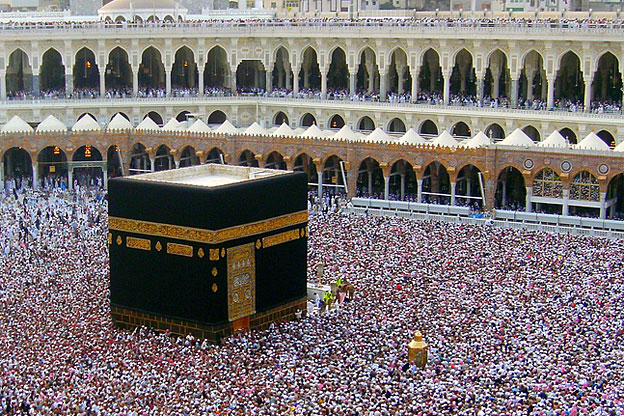
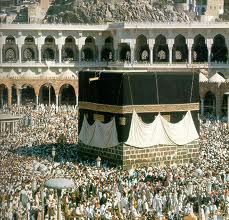
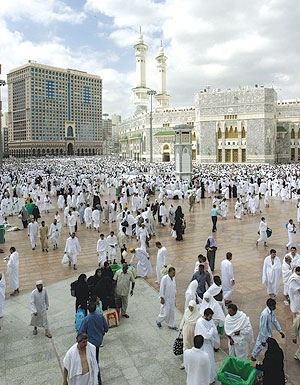
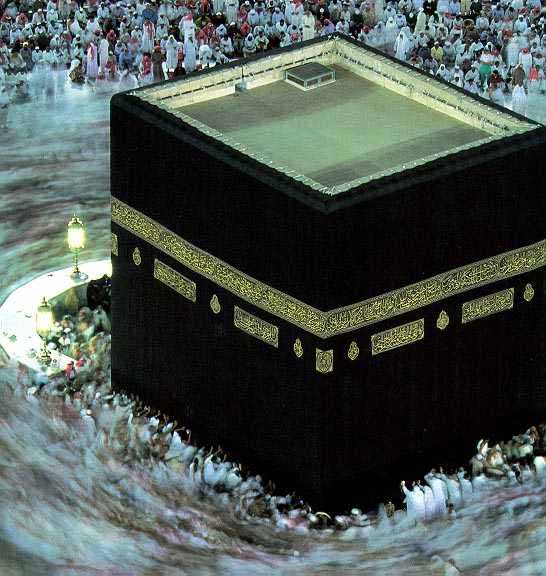
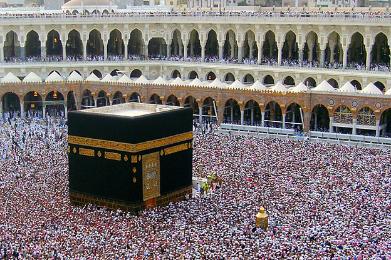
It is the irony of history that the fragment of a flying meteor landing in the deserts of West Arabia should become the holy relic of a religion which has for its creed the unity of God, and has been iconoclastic through its long history. At the centre of the world of Islam is the Ka’aba, situated in the Mosque court at Mecca. To this sacred shrine pilgrims have journeyed for thirteen hundred years. Towards this shrine every Muslim, praying directs his gaze. Towards the meridian of the Ka’aba all faces of the dead are turned when they are laid to rest in the grave. But the Ka’aba contains no object of worship, save the famous Black Stone, embedded in the walls, about five feet above the ground, and now worn smooth by the touch and the kisses of thousands of pilgrims.
Before the Hegira, Muhammad made Jerusalem the direction of prayer, but when he was established at Medina, his change of attitude towards Arabian paganism was shown first by the qibla edict (Surah 2:136-145). In this way the old heathen cult became a part of Islam and henceforth the eyes of all the faithful were turned towards Mecca.
The Black Stone is at the eastern corner of the Ka’aba, and the pilgrims in the days of Arabian paganism, when they made their circuit, began at this point as they do today. The entrance to the Ka’aba is not in the middle wall, but close to the Black Stone. Between the Black Stone and the door of the Ka’aba is the so-called Multzam, or sacred place of refuge where pilgrims press themselves against the wall, cling to the curtain and take their oaths and vows. The Black Stone is often called the corner-stone (al rukn) as though there were no other corner to the Ka’aba.
|
The pre-Islamic sacredness of the Ka’aba did not consist in the idols found there. The Black Stone was the actual sanctuary. The Ka’aba was only an extension of this stone and partook of its sanctity. It was therefore not a temple for idols, but itself an idol, a holy stone.
All the accumulation of superstition of Arab paganism which had gathered in and around the Ka’aba was destroyed by Muhammad, when he completed the conquest of Mecca. The interior of the Ka’aba was cleansed and its pantheon of idols destroyed, with the exception of the Black Stone. Not only were there images but pictures in the heathen shrine. When they began to wash off the pictures of the Prophets with zem-zem water, Muhammad is said to have placed his hands on the pictures of Jesus and Mary, saying, “Wash out all except what is below my hands” (Wensinck in Encyclopaedia of Islam, Article on “The Ka’aba,” p. 587). If this tradition is reliable, it throws considerable light on the attitude of Muhammad toward Christianity at this time. Cleansed of its idols the Ka’aba became the fifth pillar in the Muslim temple of truth.